
Is Your Marketing Actually Working? Here’s How to Tell Without Guessing
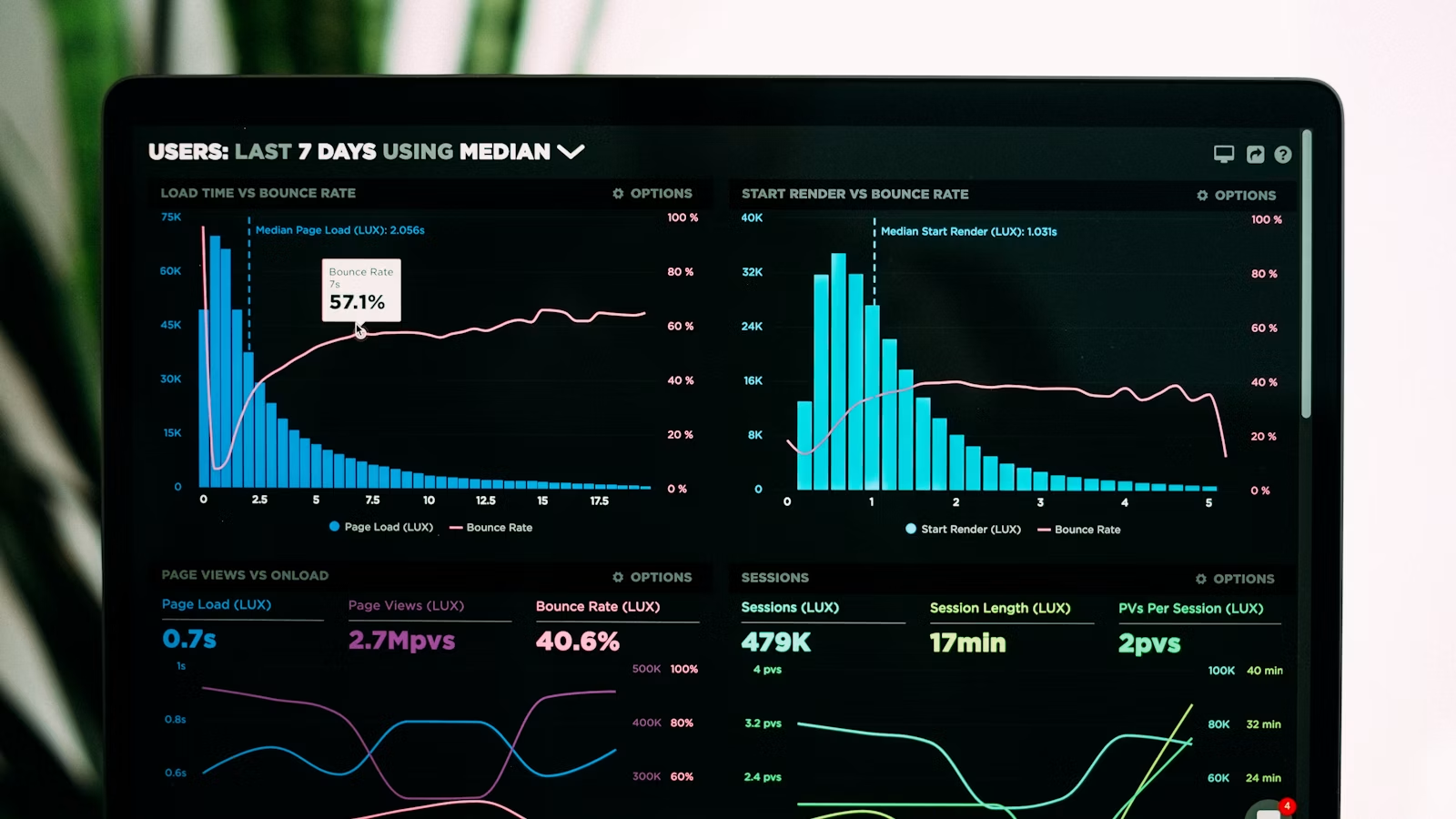
Ask any small business owner whether their marketing is working, and you’ll usually get one of two answers: a confident yes that falls apart under two follow-up questions, or an honest shrug. I’ve had this exact conversation more times than I can count, and the shrug is the more common one by far.
That’s not a knock on anyone. A 2026 survey by Enji found that four in five small business owners rate their own marketing as, at best, somewhat effective [1]. Constant Contact’s most recent research puts small business marketing confidence at just 18% globally [2]. A separate 2026 analysis found that 73% of small business owners have no real confidence in their marketing strategy at all [3]. If you’ve ever quietly wondered whether your monthly ad spend is doing anything, you’re in the majority, not the exception.
Here’s the useful part: you don’t need a marketing degree or an expensive analytics platform to answer this honestly. You need three numbers, and you probably already have most of the raw data sitting in a spreadsheet or your point of sale system. This is about which three numbers, and just as importantly, which ones you can stop obsessing over.
You’re Not the Only One Who Can’t Tell

This isn’t only a small-business problem, either. A 2026 CEO survey found that just 13% of CEOs are very confident their marketing team can show incremental financial impact, even though most of them say their marketing goals are aligned with the business [4]. Sixty percent now view marketing as a cost center rather than a growth driver, a sharp reversal from prior years [4]. Separately, Gartner found that only 52% of marketing leaders felt they’d successfully proven marketing’s value to the rest of the business, and named CFOs and CEOs as the executives most skeptical of that value [5]. If people with entire analytics teams can’t answer this cleanly, there’s no reason to feel bad that you can’t either.
What the Data Shows
| Finding | Source |
|---|---|
| 4 in 5 small business owners rate their marketing as, at best, “somewhat” effective | Enji, State of Small Business 2025 [1] |
| Small business marketing confidence sits at 18% globally | Constant Contact, Small Business Now Report [2] |
| 73% of small business owners lack confidence in their marketing strategy | RevenueMemo, 2026 analysis [3] |
| Only 13% of CEOs are very confident marketing can show financial impact | Boathouse CEO study via CommPRO, 2026 [4] |
| Only 52% of marketing leaders feel they’ve proven marketing’s value internally | Gartner, via Sword and the Script, 2025 [5] |
Why This Is So Hard to Answer Honestly
Most Reports Measure What’s Easy, Not What Matters
Impressions, reach, follower counts, and cost per lead are all easy to pull from a dashboard, so they end up in every report. A HubSpot analysis of what CEOs actually want to see put it plainly: these are interim steps, and most business owners care more about the cost and the net result than the steps in between [6]. A lead that never buys anything is not a result. It’s an interim step that made the report look busy.
Nobody Has Perfect Attribution, and That’s Fine
Someone sees your ad on Instagram, forgets about it for two weeks, asks a friend, then finds you by searching your business name directly. Which channel gets credit for that sale? Depends who you ask, and honestly, it doesn’t fully matter. You don’t need perfect attribution. You need consistent, good enough tracking that you trust more than a shrug.
Three Numbers That Actually Tell You Something
1. Real Cost Per Customer, Not Cost Per Lead
Cost per lead flatters almost any campaign, because leads are cheap and plentiful. What matters is cost per paying customer: total spend on a channel, divided by the number of people from that channel who actually bought something, in the same period. Run €800 through Instagram ads and get 40 leads and 3 paying customers, and your real cost per customer is about €267, not the flattering €20-per-lead number sitting in the report. For a legal services business with a long decision cycle, this number might take two or three months to settle, but it’s still the only one worth tracking to a decision.
2. Revenue By Channel, Not Clicks By Channel
This one doesn’t require expensive software. A basic UTM tag on every link you share, or simply asking new customers how they found you at checkout or intake, gets you most of the value of a full attribution platform for a fraction of the effort. For an e-commerce store, that might mean tagging every Instagram story link separately from every Google ad. The goal isn’t a perfect model. It’s knowing which channel’s leads turn into revenue, not just which channel gets the most clicks.
3. Repeat Rate
For food delivery and e-commerce businesses especially, the first order rarely pays for itself once you count the acquisition cost. The number that actually predicts whether a channel is profitable is what percentage of new customers order again within 60 or 90 days. A channel that brings in cheap first orders but never turns into repeat customers hasn’t found you a bargain. It’s found you a slow way to lose money on every new customer, one order at a time.
Two Numbers You Can Stop Worrying About
- Impressions and reach. They tell you an ad was shown, not that anyone cared.
- Follower count and likes. A large following with no repeat customers is a hobby, not a growth channel.
None of this means these numbers are meaningless everywhere. If your goal is genuinely brand awareness ahead of a future launch, they have a place. But if you’re checking them every week hoping they’ll tell you whether this month’s spend was worth it, they won’t.

A 15-Minute Exercise You Can Run This Week
- Pull last month’s total spend by channel. Ads, agency fees, tools, all of it.
- Count actual paying customers per channel, not leads. Check your sales or checkout data, or just ask five recent customers how they found you.
- Divide spend by paying customers per channel. That’s your real cost per customer.
- Compare it to what an average customer is worth to you over their first year. If the cost is higher than the value, that channel is quietly losing you money no matter how good the click-through rate looks.
Frequently Asked Questions
How often should I check these numbers?
Monthly is usually enough for cost per customer and channel revenue. Repeat rate needs a longer window, at least 60 to 90 days, or you’ll be reading noise instead of a trend.
What if I don’t have this data at all right now?
Start with the ask: whenever someone becomes a paying customer, ask how they heard about you and write it down somewhere, even a shared spreadsheet. A month of consistent, imperfect data beats a year of no data.
Is this the same as what my agency should already be reporting?
It should be, and if it isn’t, that’s worth a direct conversation. A report full of impressions and engagement with no line connecting spend to paying customers isn’t a report. It’s a highlight reel.
If You Want a Second Set of Eyes
This is roughly the first thing I look at with any business before we talk about strategy. Not because the numbers are complicated, but because most owners have never had someone sit down and actually calculate them properly. If you want help running this exercise on your own numbers, that’s exactly what RADBOR’s audit is for.
Send me a note at [email protected]. I read every one personally.
— Lasha
Sources
- Enji, “State of Small Business 2025,” as reported by Barchart — barchart.com
- Constant Contact, “Small Business Now Report” — constantcontact.com
- RevenueMemo, 2026 analysis, as reported by Greater Lafayette Commerce — greaterlafayettecommerce.com
- Boathouse CEO study, as reported by CommPRO — commpro.biz
- Gartner survey data, via Sword and the Script — swordandthescript.com
- HubSpot, “The 6 Key Marketing Metrics Your CEO Actually Cares About” — blog.hubspot.com
BLOG
More Growth Notes